 Tire or Crawler Type
 50-500tph
 3-axle chassis, ⬆60% Faster Transfer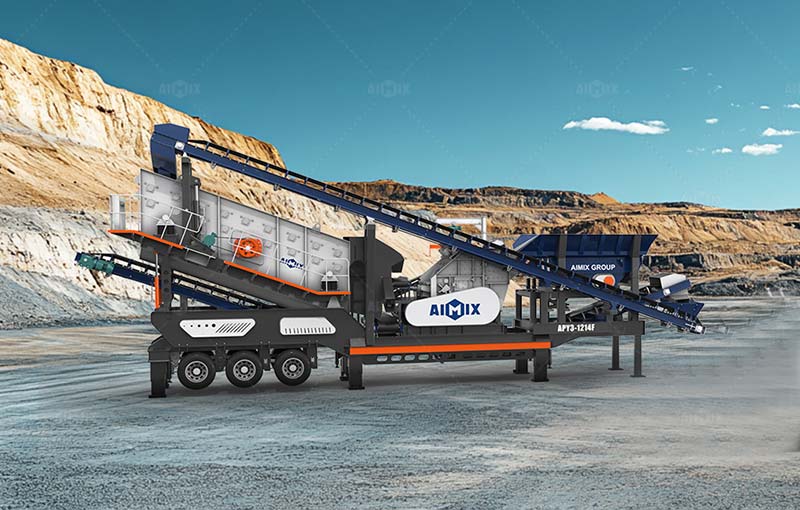
APY3 Impact Type Mobile Crusher Plants – Low Production Cost
1. Capacity and Configuration:
- Production Capacity Range: 70–500 T/H
- Typical Configuration: Feeder + Impact Crusher + Vibrating Screen
2. Material and Operating Condition Suitability
- Material Hardness Range: Medium-soft to medium hardness, like construction waste, concrete, asphalt blocks, limestone, dolomite, etc.
- Maximum Feed Size: ≤300mm
- Finished Product Requirements: 0–40 mm, high cubic content, low flaky and elongated particle content
3. Output Quality
- Excellent Particle Shape: The impact crushing principle results in better cubic particles, suitable for recycled aggregates, base/surface course aggregates.
- Adjustable Particle Size: Adjustable discharge grate gap and rotation speed allow for precise control of 0–40 mm output.
4. Application Scenarios
- Construction demolition and solid waste resource utilization (C&D waste)
- Road renovation and asphalt recycling
- Secondary/tertiary crushing in quarries, especially for limestone

APY3 Jaw-Type Mobile Crusher Plant – Primary Crushing
1. Capacity and Configuration
- Capacity Range: 45–400 T/H
- Configuration: Feeder + Jaw Crusher + Vibrating Screen
2. Material and Working Condition Adaptability
- Applicable Materials: Medium to high-hardness rocks, such as granite, basalt, limestone, river pebbles, large concrete blocks from building demolition, etc.
- Feed Size: Large feed opening, supporting raw materials >425 mm
- Working Conditions: Primary crushing in quarries, pre-crushing of mine overburden, coarse crushing of large concrete blocks from building demolition
3. Output and Subsequent Processes
- Finished Product Particle Size: 15–300 mm can be obtained through screening; in most scenarios, it serves as coarse material before secondary crushing
- Particle Shape Characteristics: Jaw crusher output has distinct edges, making it more economical as raw material for subsequent shaping/secondary crushing
Cost and Mobility
4. Typical Application Scenarios
- Primary crushing in quarries and mines
- Building demolition/solid waste – pre-crushing of large concrete blocks + magnetic separation
- Temporary construction material yards, on-site sand/stone production for road construction
Rapid expansion of the global construction industry Large-scale infrastructure projects, road construction, and urban development continue to increase the demand for on-site aggregate production..
Accelerated urbanization and infrastructure development Cities require faster, more flexible crushing solutions that reduce material transportation and improve project efficiency..
Growing demand for manufactured sand (M-sand) As natural river sand resources decline, manufactured sand has become a cost-effective and environmentally friendly alternative, further driving the need for reliable crushing and screening equipment.
The mobile crushing plant is transported to the job site and set up. Its mobility allows it to be moved closer to the material source.
Raw materials are fed into the feeder, which regulates the amount of material entering the mobile crusher.
The material is crushed in the crusher, where it is broken down into smaller pieces. The type of crusher machine used will determine the final size and shape of the material.
After crushing, the material may go through a screening process to separate it into different sizes. Oversized materials can be sent back for further crushing.
The processed material is then discharged onto conveyor belts or directly into trucks for transport.
Once the site’s material is processed, the mobile plant demonstrates its core value: rapid mobility. The conveyors are folded in, the mobile crusher is lowered and secured, and it is ready to move. Wheeled crusher plants hook to a truck for highway-speed towing to the next site. Tracked crusher plants use their own propulsion to crawl to the next pile or loading area on site, often without needing a transport vehicle. This step, taking mere minutes to hours instead of days, enables zero downtime between jobs and maximizes productive uptime.
 |
 |
 |
|---|---|---|
| Moves independently on-site using tracks; ideal for construction or demolition sites with uneven, muddy, or rough terrain | Mobility | Moves on paved or solid ground; best for urban projects or sites that require frequent relocation over long distances |
| Excellent — handles slopes, soft ground, and off-road conditions; suitable for mines, quarries, and rough job sites | Terrain Adaptability | Limited — requires flat, hard surfaces; recommended for highways, urban road construction, and aggregate plants on even ground |
| Quick on-site setup; can start crushing immediately after positioning; perfect for flexible, multi-location projects | Setup & Relocation | Fast on paved surfaces, but often needs additional equipment for site changes; ideal for projects on smooth, easily accessible roads |
| Generally higher upfront cost due to track system; justified for long-term projects with tough terrain | Investment Cost | Usually lower initial investment; good for budget-sensitive projects or short-term assignments |
| Track system requires regular inspection; extremely reliable in harsh conditions, suitable for heavy-duty long-term operations | Maintenance | Tires are easier to maintain; less wear on smooth surfaces; suitable for light to medium-duty projects and urban sites |