- Get the right plant solution to launch your business with greater confidence
- Choose equipment that matches your business goals and helps control upfront costs
- Improve operational efficiency and create sustainable business growt
When planning to launch a concrete batching plant business, you likely have several practical concerns: Is there stable local demand? What production capacity should you choose? How much initial investment is required? Will the equipment remain usable as the business expands?
These are all factors that require advance planning when establishing concrete production capabilities. A well-designed concrete batching plant solution does more than just meet current project needs; it helps you strike the right balance between investment costs, production efficiency, and future growth.
Choosing the Right Business Model for Your Concrete Mixing Plant
When establishing a concrete batching plant business, you can choose from various operational models based on your available resources, project types, and long-term strategic goals. Some operators aim to supply ready-mixed concrete to the local market, while others seek to secure a reliable concrete supply for their own construction projects.
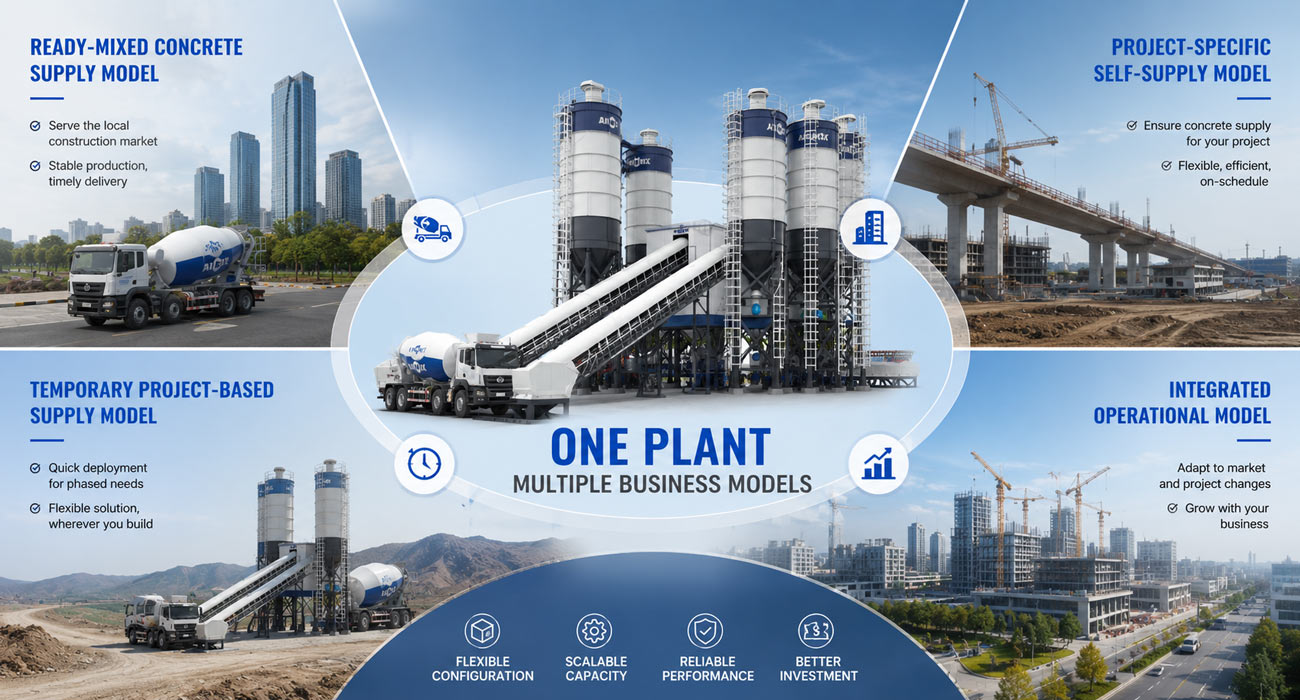
These different models entail distinct requirements regarding equipment capacity, site layout, and operational procedures. Therefore, clarifying your business direction before planning the project will help you select the most suitable equipment configuration, ensuring that your investment and subsequent operations align effectively with your actual needs.
Ready-Mixed Concrete Supply Model: Serving the Local Construction Market
If you aim to build a long-term business based on the production and sale of concrete, the ready-mixed concrete supply model is a common choice.
In this model, you establish a ready mix concrete batching plant to manufacture various grades of concrete tailored to the needs of surrounding construction projects. You then use transport equipment to deliver the concrete to sites such as real estate developments, road construction projects, and industrial facilities.
This model is particularly suitable for:
- Areas with sustained demand for construction
- Investors seeking to establish a long-term concrete supply business
- Operators with the capability to develop the local market
For such projects, stable production capacity and reasonable operating costs are crucial. Selecting a batching plant capacity that aligns with local demand helps avoid prolonged equipment idleness while ensuring daily order fulfillment.
Project-Specific Self-Supply Model: Ensuring Concrete Supply for the Project
If you are directly involved in construction, building your own concrete batching plant allows for greater flexibility in managing the concrete supply required for the work.
Examples include:
- Commercial housing projects
- Bridge and highway engineering
- Large-scale infrastructure projects
In these projects, concrete demand is typically concentrated within specific construction phases. Having an on-site or nearby batching plant reduces waiting times for external supplies and simplifies the scheduling of construction activities. This model prioritizes factors such as equipment mobility (ease of relocation), installation efficiency, and alignment with the project schedule.
Temporary Project-Based Supply Model: Meeting Phased Construction Needs
For engineering projects with clearly defined construction periods and relatively isolated locations, concrete supply capabilities often need to be established quickly in line with project progress. Unlike long-term, fixed-market supply models, this approach focuses on rapidly deploying production capacity within a limited timeframe to meet concrete requirements across different project stages.
Examples include:
- Projects in remote areas
- Temporary road construction
- Short-term, large-scale construction tasks
In these scenarios, you may face challenges such as construction sites being far from urban centers—resulting in long transport distances for external supplies—or limited project timelines that necessitate the rapid establishment of on-site production capabilities. Consequently, a flexible and efficient concrete production solution helps you better coordinate with the construction schedule while mitigating the time and cost pressures associated with long-distance transportation.
Integrated Operational Model: Flexible Adaptation to Market and Project Needs
As demand in the concrete market constantly shifts, investors often prefer not to limit their batching plant operations to a single project or client base; instead, they seek a more flexible operational approach that allows the plant to continuously serve diverse construction requirements.
For instance, depending on local market conditions, you can:
- Supply ready-mixed concrete to nearby construction projects;
- Participate in concrete supply for large-scale engineering projects as they launch;
- Adjust production schedules based on seasonal trends and market demand;
- Gradually scale up production capacity as the business grows.
The key characteristic of this model is that the batching plant serves not merely as a set of production equipment, but as a sustainable production asset. At the same time, this approach requires the equipment to offer sufficient flexibility, enabling you to incrementally adjust production capacity in line with business expansion.
Regardless of the concrete batching plant business plan model you choose, the key lies in aligning equipment capabilities with actual demand. Once you have clarified your business direction, you can determine the appropriate production scale, equipment configuration, and investment plan.
Next, we will analyze—from the perspectives of market demand and long-term operations—why an increasing number of people are choosing to enter the concrete batching plant business.
Concrete Mixing Plant: Building a Long-Term Business with Reliable Potential
With the ongoing development of infrastructure and engineering projects, concrete remains a fundamental construction material with consistently stable demand. For you, investing in a concrete batch plant business for sale is not merely about purchasing production equipment; it is about establishing a production capability designed for long-term operation.
Naturally, market conditions, investment budgets, and development goals vary from project to project. Therefore, understanding the long-term value of this sector before deciding to launch a concrete plant business for sale can help you plan your future direction with greater clarity.
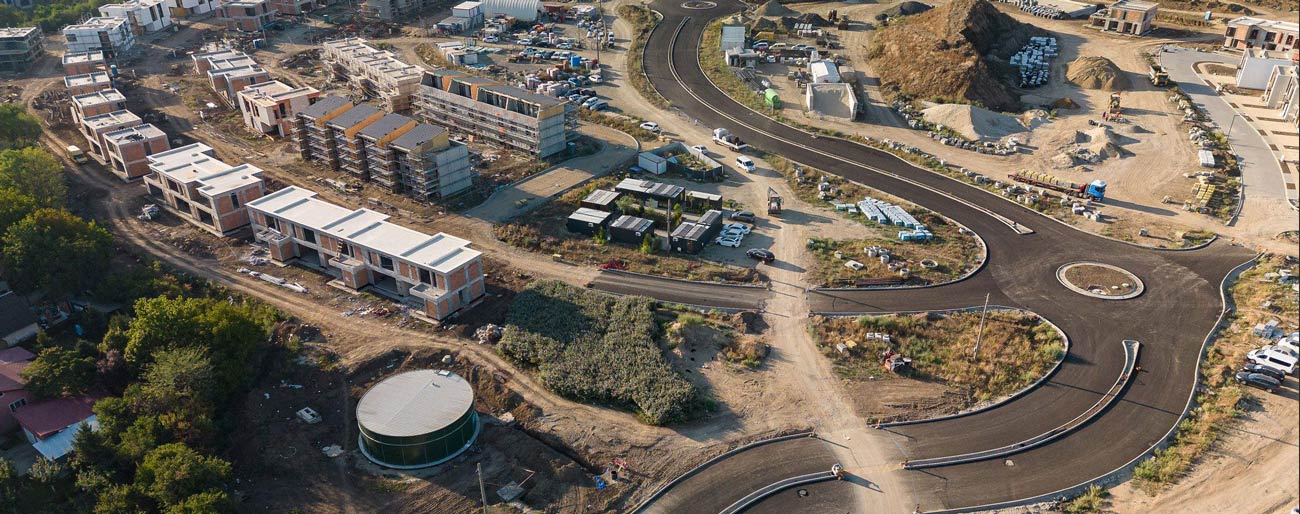
Stable industry demand provides a foundation for business growth
From residential construction to roads, bridges, and industrial projects, concrete remains an indispensable material in engineering and construction. Sustained demand for infrastructure projects provides a solid foundation for the long-term growth of concrete supply operations.
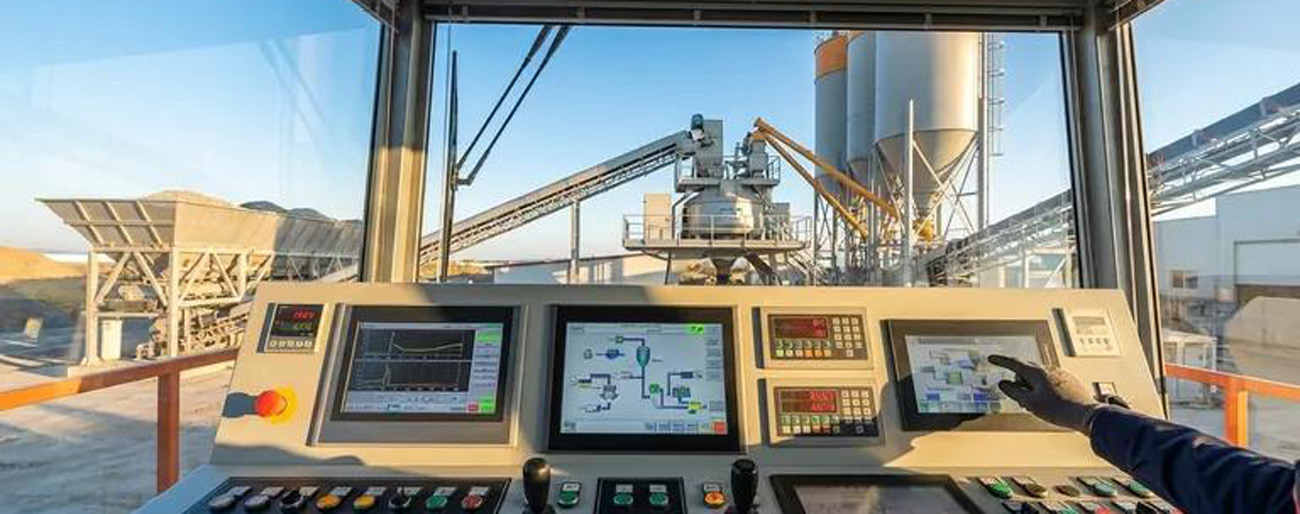
In-house production capabilities give you greater operational control
Establishing your own concrete batching plant allows you to schedule production based on specific project needs; you are no longer solely reliant on external suppliers, making it easier to manage delivery timelines and production pacing.
Flexible investment scales to suit different stages of growth
Concrete batching plants offer various investment models. You can select equipment configurations tailored to local market demand, project scale, and future plans, allowing you to start small and expand progressively.
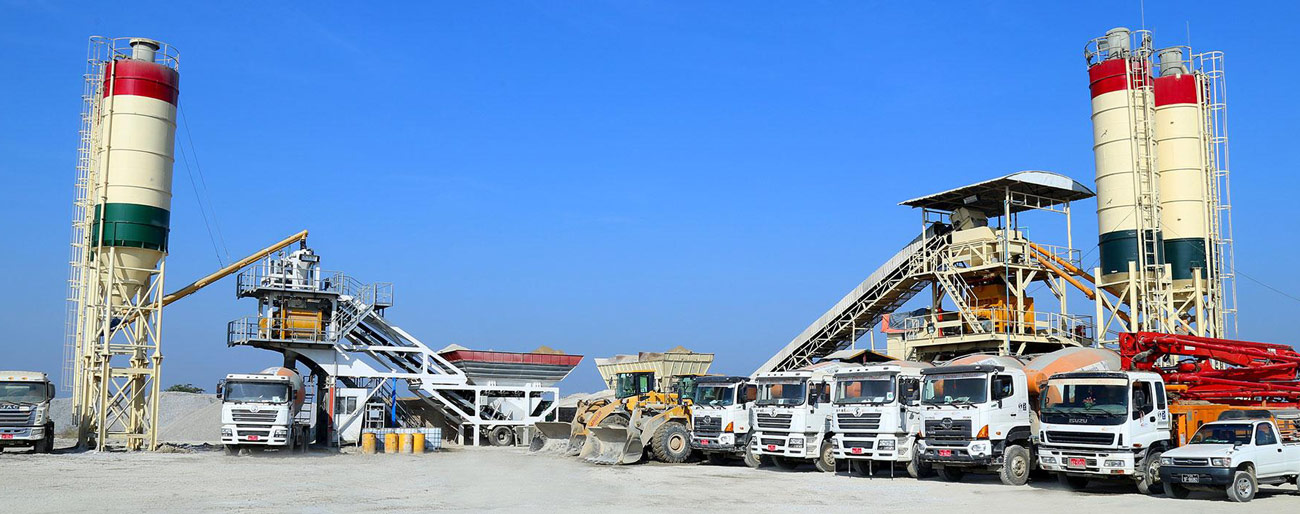
Integrated production and supply enhance long-term operational value
With in-house production capabilities, you can directly manage raw materials, production processes, and supply logistics, making it easier to control overall operating costs over the long term.

Scalability supports continuous business growth
As market demand rises, you can expand your batching plant operations—whether by upgrading equipment, extending your supply radius, or serving more projects—in alignment with your strategic plans.
With the ongoing advancement of urban development, infrastructure upgrades, and various engineering projects, concrete remains a vital material in infrastructure construction, maintaining steady market demand. Naturally, running a successful concrete batching plant business requires aligning with the local market and project resources while implementing a sound equipment strategy. However, by proactively planning your operational model, managing investment costs, and selecting production equipment that meets your specific needs, you can gradually establish a reliable concrete supply capability and capitalize on growth opportunities in this sector.
Find the Right Concrete Mixing Plant Solution for Your Business Plan
When starting a concrete business, equipment selection requires weighing multiple factors—such as the types of projects you intend to serve, projected production scale, site conditions, and the future direction of your business.
We understand that every concrete batching plant has unique goals: some clients aim to establish a stable, long-term concrete supply base; others require the flexibility to relocate the plant to match specific engineering projects; and some prefer to start small and scale up gradually. To address these diverse needs, AIMIX offers a wide range of concrete batching plant solutions, enabling you to select the production setup that best aligns with your business plan and ensures the equipment effectively supports your long-term operational objectives.
Long-term Concrete Batching Plants: Establishing a Stable Supply Hub
If your goal is to establish a long-term, local concrete supply business, such as serving surrounding construction projects, infrastructure projects, or the ready-mixed concrete market, the AJ series stationary batching plant is often a better choice.
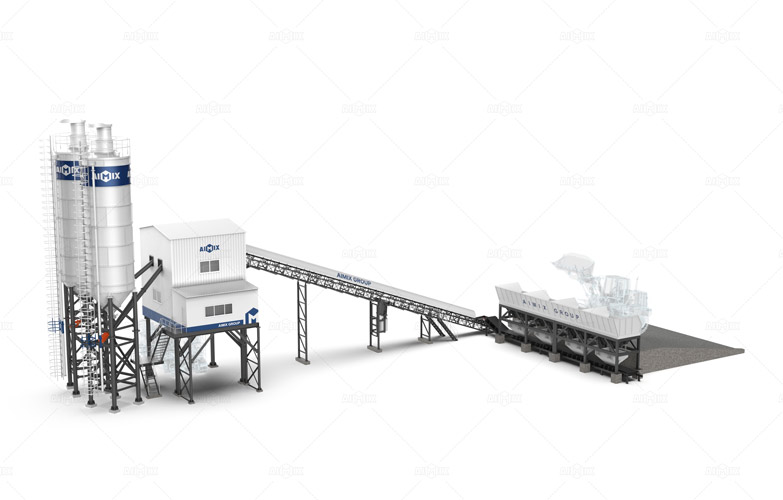
- Stable production capacity for long-term operations: The AJ series features a comprehensive configuration designed to meet the demands of continuous, high-volume concrete production. A consistent daily output enables you to reliably handle ongoing project orders.
- Automated control to ease operational management: Automated control systems ensure precise batching and efficient production management. This minimizes human error, ensures consistent concrete quality, and simplifies long-term operational management.
- Comprehensive configuration for long-term value: Stationary plants offer excellent scalability, allowing configurations to be adjusted as your business grows, ensuring the equipment continues to deliver value over the long term.
| Type | Belt Type | |||||
|---|---|---|---|---|---|---|
| Model | AJ60 | AJ90 | AJ120 | AJ180 | AJ240 | AJ270 |
| Theoretical productivity (m³/h) | 60 | 90 | 120 | 180 | 240 | 270 |
| Mixer discharge volume (L) | 1000 | 1500 | 2000 | 3000 | 4000 | 4500 |
| Mixer feeding volume (L) | 1500 | 2250 | 3000 | 4500 | 6000 | 6750 |
| Mixer power (kw) | 18.5×2 | 30×2 | 37×2 | 55×2 | 75×2 | 75×2 |
| Discharge height (m) | 4.1 | 4.1 | 4.2 | 4.2 | 4.2 | 4.2 |
| Aggregate bin configuration (number × single bin volume, m³) | 4×7 | 4×15 | 4×20 | 4×25 | 4×30 | 4×30 |
| Cycle time (s) | 60 | 60 | 60 | 60 | 60 | 60 |
| Maximum aggregate particle size (mm) | 80/100 | 80/100 | 80/100 | 80/100 | 80/100 | 80/100 |
| Cement silo (optional) | 2×100 | 3×100 | 4×100 | 4×100 | 4×100 | 4×100 |
| Aggregate weighing system | ±2% | ±2% | ±2% | ±2% | ±2% | ±2% |
| Powder weighing system | ±1% | ±1% | ±1% | ±1% | ±1% | ±1% |
| Water weighing system | ±1% | ±1% | ±1% | ±1% | ±1% | ±1% |
| Additive weighing system | ±1% | ±1% | ±1% | ±1% | ±1% | ±1% |
| Installed power (kw) | ≈110 | ≈160 | ≈220 | ≈290 | ≈340 | ≈340 |
| Control mode | Fully automated computer (PC) control | |||||
| Power supply | 220V/415V/440V/380V, 50Hz/60Hz, three-phase | |||||
Project-Flexible Concrete Batching Plants: Rapid Deployment to Meet Project Needs
If your business mainly revolves around engineering projects such as roads, bridges, and infrastructure, or if the construction site may change, the AJY series mobile concrete batching plant can provide you with more flexible production solutions.
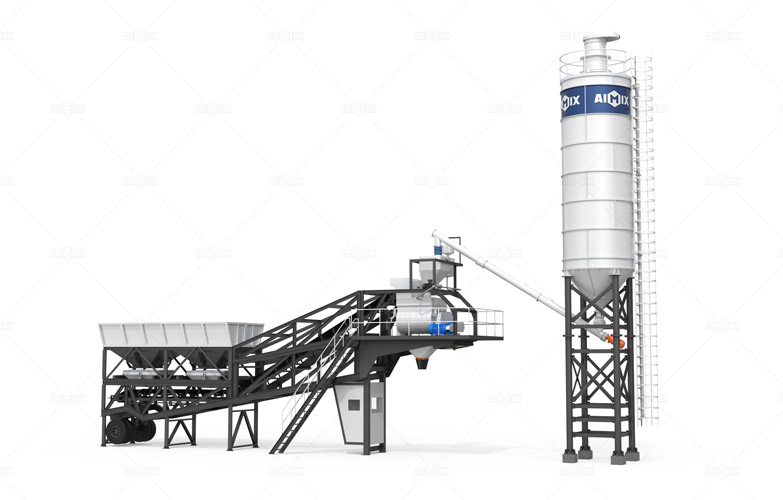
- Minimal site constraints for flexible deployment: The AJY series features a design optimized for easy relocation. Equipment placement can be adjusted based on the project site, making it easier to meet concrete supply demands across various locations.
- Reduced setup time for faster production starts: Rapid installation and startup are crucial for projects with tight schedules. The mobile design minimizes on-site construction work, allowing you to establish concrete supply capabilities quickly.
- Adaptability for multiple projects and high equipment utilization: Once a project concludes, the equipment can be reconfigured for new requirements, allowing your production assets to serve a wider range of projects.
| Types | Belt Type | ||
|---|---|---|---|
| Model | AJY-25 | AJY-35 | AJY-50 |
| Theoretical Productivity (m³/h) | 25 | 35 | 50 |
| Mixer Model (Mixer Output L) | JS500 | JS750 | JS1000 |
| Mixer Power (kW) | 18.5 | 30 | 2×18.5 |
| Mixing Cycle Period (s) | 72< | 72 | 72 |
| Rated Input Volume (Model of Batching Machine L) | 800 | 1200 | 1600 |
| Max.Aggregate Size (mm) | Φ60 | Φ60 | Φ60 |
| Standard Aggregate Bin Capacity (m³) | 2×3 | 2×5 | 2×5 |
| Category of Aggregate | 3/4/2002 | ||
| Powder Storage Silo (ton) (Optional) | 1×50 | 2×50 | 1×100 |
| Max. Discharging Height (m) | 3.8 | 3.8 | 4.1 |
| Weighing Range & Accuracy of Aggregate (kg) | (300~1500)±2% | (300~1500)±2% | (300~3000)±2% |
| Weighing Range & Accuracy of Cement (kg) | (100~300)±1% | (100~300)±1% | (250~900)±1% |
| Weighing Range & Accuracy of Water (kg) | (60~150)±1% | (60~150)±1% | (80~300)±1% |
| Weighing Range & Accuracy of Additive (kg) | / | (8~20)±1% | (8~20)±1% |
| Overall Weight (ton) | ≈15 | ≈22 | ≈26 |
| Installation Power (kW) | ≈61 | ≈73 | ≈92 |
| Power Supply | 380V/220V/415/440V, 50/60HZ, 3Phase | ||
Flexible-Start Concrete Batching Plants: Launching a Business with Reasonable Investment
For those looking to enter the concrete supply sector, or primarily serving small to medium-sized engineering projects, the AJSY series of portable concrete batch plant offers a more flexible way to start a business.
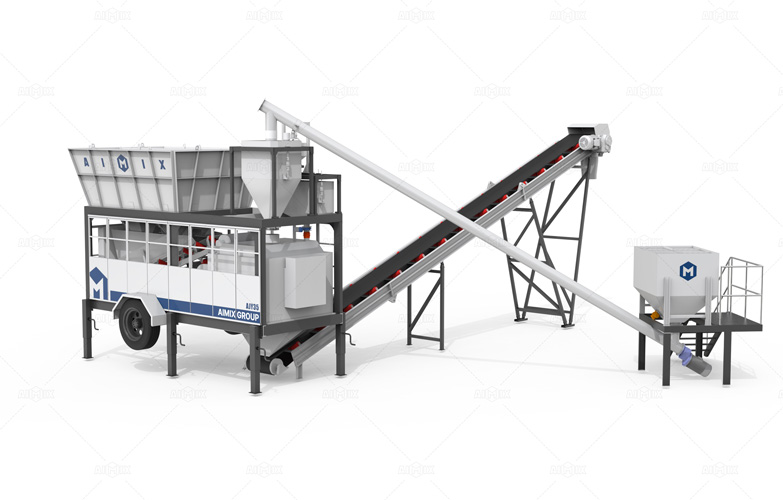
- Lower initial investment, simplifying business planning: The scale of the AJSY series is ideally suited for small-to-medium-sized projects, helping you control upfront equipment costs while establishing essential concrete production capabilities.
- Compact footprint, adaptable to diverse construction environments: For projects with site constraints, the small, portable design eases equipment layout challenges, making it easier to find a suitable installation location.
- Simplified operation and maintenance for daily management: The equipment features a relatively compact structure that facilitates easy daily management and maintenance—an ideal choice for users looking to build operational experience gradually.
| Parameter | AJSY20 | AJSY40 |
|---|---|---|
| Theoretical productivity (m³/h) | 20 | 40 |
| Mixer discharge volume (L) | 500 | 1000 |
| Mixer feeding volume (L) | 750 | 1500 |
| Mixer power (kw) | 18.5 | 18.5×2 |
| Discharge height (m) | 4.1 | 4.1 |
| Aggregate bin configuration (number × single bin volume, m³) | 2×4.5 | 2×4.5 |
| Cycle time (s) | 60 | 60 |
| Maximum aggregate particle size (mm) | 60/80 | 60/80 |
| Cement silo (optional) | 1×100 | 1×100 |
| Aggregate weighing system | ±2% | ±2% |
| Powder weighing system | ±1% | ±1% |
| Water weighing system | ±1% | ±1% |
| Additive weighing system | ±1% | ±1% |
| Installed power (kw) | ≈50 | ≈70 |
| Control mode | Buttons + Touch Screen + Remote Control | |
| Power supply | 220V/415V/440V/380V, 50Hz/60Hz, three-phase | |
Basic Concrete Supply Solution: Meeting fundamental production needs
If your project primarily focuses on basic concrete production needs and you prefer a simpler production configuration, the AJZY series drum-type small concrete plant can be considered as an economical option.
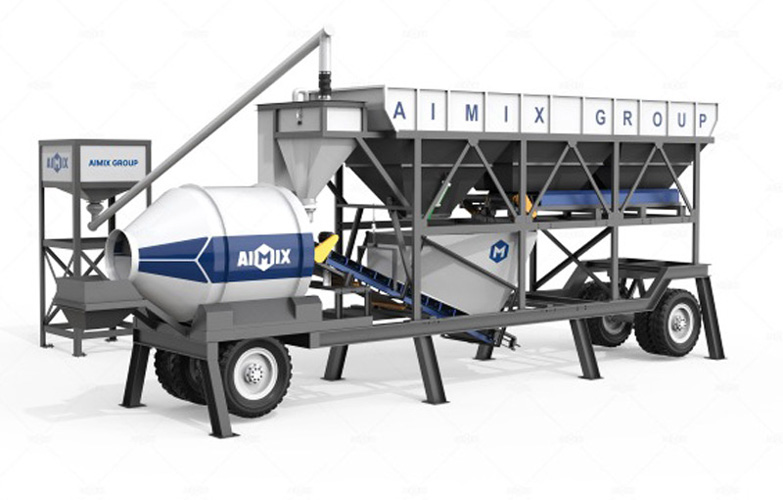
- Streamlined configuration for basic production needs: With its relatively simple structural design, the AJZY series meets the fundamental concrete production requirements of smaller-scale projects.
- Flexible investment for specific applications: For projects with limited production demands or shorter timelines, this simplified solution allows you to establish basic production capabilities with a lower initial investment.
- Easy maintenance and reduced management demands: The simple structure makes maintenance procedures easy to master, making it suitable for projects with basic production requirements.
| Parameter | Model | Unit | AJZY-40 | AJZY-60 |
|---|---|---|---|---|
| Theoretical production efficiency | Cubic meters per hour | 30-40 | 50-60 | |
| Drum mixer | -Kilowatts | JZM1000 | JZM1500 | |
| Motor power | kW | 7.5×2 | 11×2 | |
| Mixing time | second | 40 | 40 | |
| Discharge height | meters | 1.3 | 1.3 | |
| Batching machines | Dosing machine | -cubic meters | PLD1200 | PLD1600 |
| Hopper capacity | Cubic meters | 5×2/3 | 8×2/3 | |
| Motor power | kilowatt | 4×2 | 4×3 | |