- Strategic partner of Global Fortune 500 companies, designated supplier for government projects worldwide
- Keep Your Project Moving Without Interruption
- Deliver Consistent Quality Across Every Pour
As global infrastructure investment continues to grow, the market demand for concrete mixing plants—core production equipment for road, bridge, and building construction—is steadily expanding. At the same time, the number of active concrete batching plant manufacturers in the global market is rising, resulting in significant variations in equipment quality, technical specifications, and service capabilities.
For you, this means a wider range of choices but also a more challenging selection process. Purchasing a concrete mixing plant often involves an investment ranging from hundreds of thousands to millions of dollars, with the equipment expected to operate at the project site for years or even longer. Therefore, finding a concrete batching plant supplier that truly aligns with your needs is the first step toward the success of the entire project.
What Choosing the Right Concrete Batching Plant Manufacturer Means
When making procurement decisions for a concrete batching plant, the equipment itself is often merely the starting point; the factors that truly exert a lasting impact on project operations are the concrete batching plant manufacturer’s comprehensive capabilities regarding solution design, delivery execution, and long-term support.
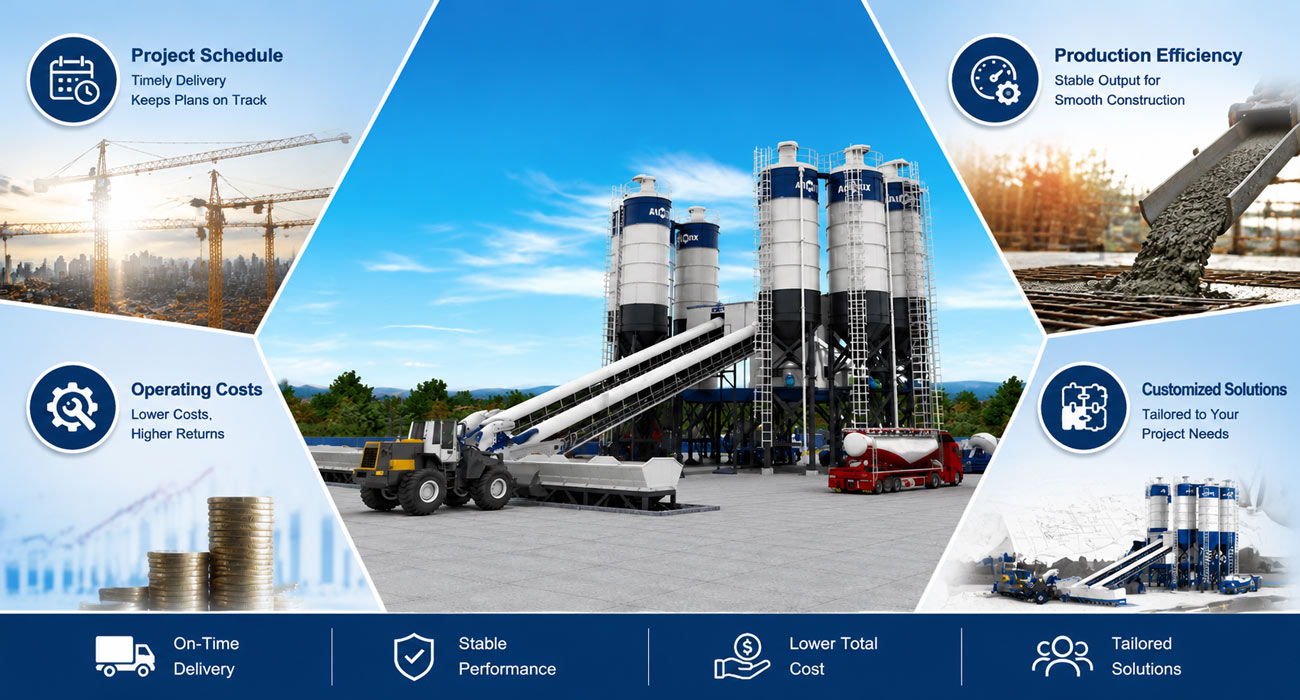
So, what exactly defines a suitable batching plant company? And in the course of actual project execution, in what ways can such a concrete batching plant manufacturer make your construction workflow clearer, more stable, and more controllable? Let us explore this question by examining several key aspects.
Project Schedule: Timely Equipment Delivery Ensures Plan Execution
Infrastructure projects typically have strict timelines; delays at any stage can trigger a chain reaction.
- Guaranteed Delivery: Concrete batching plant manufacturer with stable production capabilities can meet manufacturing and shipping milestones, ensuring your on-site installation schedule remains unaffected.
- Smoother Installation and Commissioning: Concrete batching plant manufacturer offering professional technical support can assist on-site teams in rapid commissioning, significantly shortening the time from equipment arrival to full operation.
Production Efficiency: Stable Output Ensures Consistent Pouring Rhythms
Once a batching plant is operational, the stability of its output directly dictates the pace of concrete pouring at the construction site.
- Equipment Matched to Project Needs: A suitable concrete batching plant company recommends models based on your project scale, concrete grade requirements, and daily output targets, rather than simply pushing existing inventory.
- Reliable Core Components: The quality of key components—such as the main mixer, weighing systems, and control systems—determines long-term output stability and minimizes unplanned downtime caused by equipment issues.
Operating Costs: Expenses Beyond the Purchase Price
The batching plant price is only one part of the total cost; expenses incurred during the operational phase often warrant greater attention.
- Timely Spare Parts Supply Minimizes Downtime Losses: Concrete batch plant suppliers with robust spare parts systems ensure rapid replenishment of wear parts, preventing site work stoppages caused by waiting for components.
- Controllable Energy and Maintenance Costs: Batching plants with sound designs and high-quality components incur significantly lower costs for electricity, lubrication, and routine maintenance compared to low-quality equipment.
Customized Solutions: Addressing Specialized Operating Conditions Beyond Standard Models
Not all projects can be handled by off-the-shelf, standard models. When your project involves unique construction conditions or requires high-grade concrete, a concrete batching plant manufacturer’s customization capabilities are crucial to meeting your specific operational needs.
- Adaptation for Specialized Concrete Applications: Projects such as high-speed rail, hydraulic engineering, tunneling, and prefabricated components impose strict requirements on concrete grades and admixture ratios. Suppliers capable of optimizing equipment for these specific applications ensure consistent performance that meets high standards.
- Support for Mobility and Custom Engineering: Customized configurations—such as mobile mixing plants, rapid-assembly plants, and winterized heating/anti-freeze systems—represent capabilities that standard suppliers often lack but are indispensable for specific operating conditions.
- Multi-Site Coordination Solutions: For enterprises requiring centralized management, solutions that integrate control systems, ensure parts interchangeability, and provide unified after-sales support across multiple sites can significantly reduce management costs and coordination complexities.
Qualifications and Certifications: Essential Compliance Assurance for Overseas Projects
For cross-border procurement or overseas engineering projects, a concrete batching plant manufacturer’s qualifications and certification status are not merely added bonuses but fundamental prerequisites for successful project execution.
- Comprehensive Industry Qualifications: Production licenses, equipment inspection reports, certificates of conformity, and certifications for specialized equipment serve as the basis for verifying manufacturing compliance and are mandatory requirements for site entry.
- Complete Export Support: CE certification, customs inspection documentation, export packaging, container loading plans, and multilingual operation manuals determine whether equipment can clear customs and be used legally on-site, preventing delays caused by missing paperwork.
- Clear Contractual Compliance Guarantees: Explicitly defining warranty periods, coverage, breach-of-contract penalties, and compensation standards for delayed delivery in the contract transforms concrete mixing plant manufacturer promises into tangible guarantees and is essential for avoiding disputes arising from verbal agreements in cross-border procurement.
Localized Service: Response Speed Determines Downtime Duration
When equipment issues arise, the coverage of service networks and the speed of response directly determine the extent of losses caused by downtime.
- Continuous Technical Support: The ability to quickly access remote or on-site technical support when issues occur during operation is critical to minimizing losses.
- Localized Service Network Coverage: The presence of on-site service teams or local partner maintenance engineers in your project area—backed by overseas spare parts warehousing—minimizes response delays for cross-border after-sales support, eliminating the need to wait for remote coordination from headquarters.
Long-term Partnership: A key metric for evaluating supplier capability
For enterprises with ongoing construction needs, the concrete batching plant manufacturer relationship itself constitutes an asset.
- Streamlined Repeat Procurement: Establishing a partnership with a proven concrete batching plant manufacturer significantly simplifies the selection and procurement processes for subsequent projects, thereby reducing decision-making costs.
- Extended Equipment Lifecycle Value: Suppliers with upgrade and retrofit capabilities can modernize the electrical control, dust removal, and weighing systems of aging mixing plants, avoiding the need for a complete replacement; furthermore, they can facilitate equipment buy-backs or resale upon project completion, thereby preserving residual asset value.
From delivery milestones to customization, from regulatory compliance to localized responsiveness, and from operating costs to residual equipment value—every aspect plays a role at some stage of the project’s progression. Your choice of concrete batching plant manufacturer determines not only the equipment you receive but also the level of support and assurance you will have throughout the entire project lifecycle.
Different Projects, Different Needs: Find the Right Plant
A truly capable concrete batching plant manufacturer must, first and foremost, offer a product line that aligns with your project requirements. Whether the production capacity matches the scale of your project, the equipment suits your site conditions, and the model selection offers sufficient flexibility—the answers to these questions determine the extent to which the concrete batching plant manufacturer can genuinely assist you. AIMIX currently offers four major series of batch plants, covering the full spectrum of needs ranging from large-scale infrastructure projects to small construction sites.
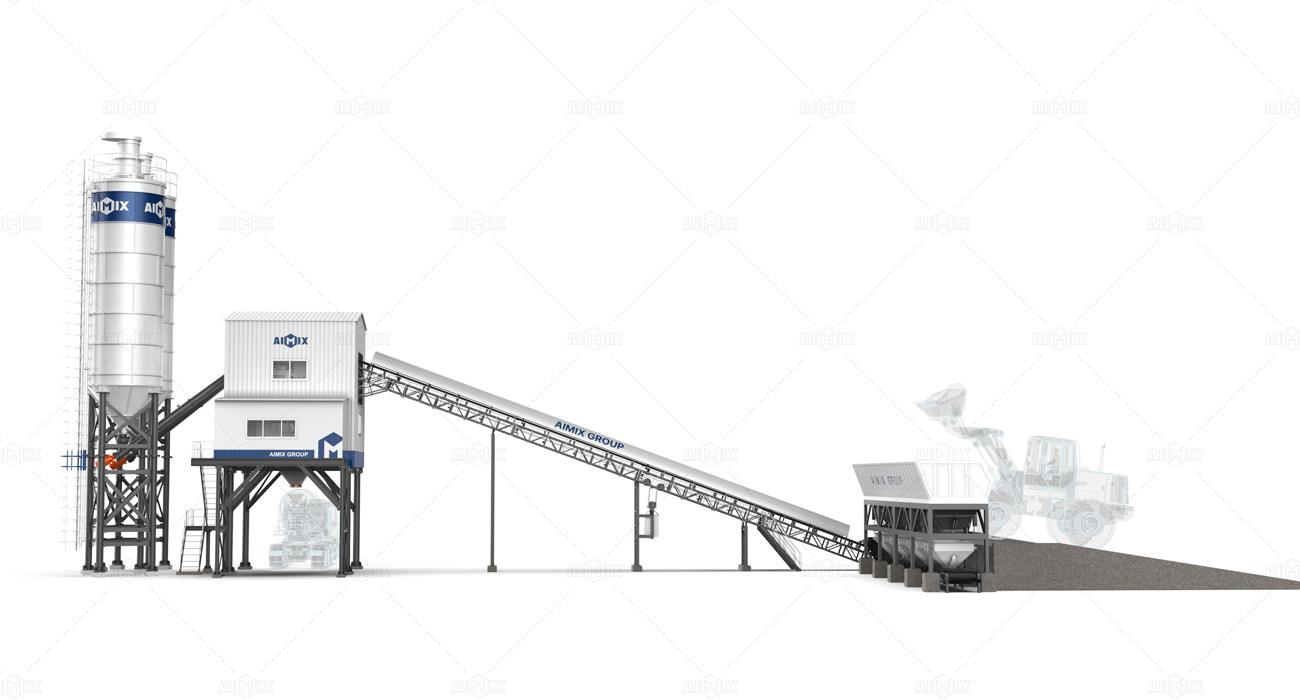
AJ Series—Consistent high output, a stable choice for long-term projects
- Capacity: 25–240 m³/h
- Mixer: Twin-shaft mixer, vertical-shaft mixer
- Mixing Cycle: 65–72 s
- Setup Time: Longer setup time (10–60 days)
Representative Model: AJ90
- Stable output, reduced waiting: A continuous capacity of 90 m³/h combined with a 60-second mixing cycle in this stationary batching plant ensures the on-site pouring pace is not slowed down by equipment capacity.
- Precise metering, controllable quality: Metering accuracy of ±1% for powders and water, and ±2% for aggregates; stable mix ratios for every cubic meter of concrete reduce the risk of quality-related rework.
- Dual operation modes, faster startup: Supports both PLC touchscreen and physical button controls; reduces startup preparation time by over 30% to accommodate different operating habits.
- Remote monitoring, early fault warning: IoT system tracks key parameters like motor temperature, vibration, and current in real-time; automatic alarms for anomalies reduce maintenance costs by 25%.
- Ample aggregate bin capacity, continuous production without material shortages: Configured with 4×15 m³ aggregate bins, supporting long periods of uninterrupted batching and reducing downtime caused by waiting for material replenishment.
- Modular maintenance access, convenient spare part replacement: Fixed layout design reserves dedicated channels for routine maintenance; wear parts can be replaced without dismantling the entire machine, resulting in shorter downtime.
| Type | Belt Type | |||||
|---|---|---|---|---|---|---|
| Model | AJ60 | AJ90 | AJ120 | AJ180 | AJ240 | AJ270 |
| Theoretical productivity (m³/h) | 60 | 90 | 120 | 180 | 240 | 270 |
| Mixer discharge volume (L) | 1000 | 1500 | 2000 | 3000 | 4000 | 4500 |
| Mixer feeding volume (L) | 1500 | 2250 | 3000 | 4500 | 6000 | 6750 |
| Mixer power (kw) | 18.5×2 | 30×2 | 37×2 | 55×2 | 75×2 | 75×2 |
| Discharge height (m) | 4.1 | 4.1 | 4.2 | 4.2 | 4.2 | 4.2 |
| Aggregate bin configuration (number × single bin volume, m³) | 4×7 | 4×15 | 4×20 | 4×25 | 4×30 | 4×30 |
| Cycle time (s) | 60 | 60 | 60 | 60 | 60 | 60 |
| Maximum aggregate particle size (mm) | 80/100 | 80/100 | 80/100 | 80/100 | 80/100 | 80/100 |
| Cement silo (optional) | 2×100 | 3×100 | 4×100 | 4×100 | 4×100 | 4×100 |
| Aggregate weighing system | ±2% | ±2% | ±2% | ±2% | ±2% | ±2% |
| Powder weighing system | ±1% | ±1% | ±1% | ±1% | ±1% | ±1% |
| Water weighing system | ±1% | ±1% | ±1% | ±1% | ±1% | ±1% |
| Additive weighing system | ±1% | ±1% | ±1% | ±1% | ±1% | ±1% |
| Installed power (kw) | ≈110 | ≈160 | ≈220 | ≈290 | ≈340 | ≈340 |
| Control mode | Fully automated computer (PC) control | |||||
| Power supply | 220V/415V/440V/380V, 50Hz/60Hz, three-phase | |||||
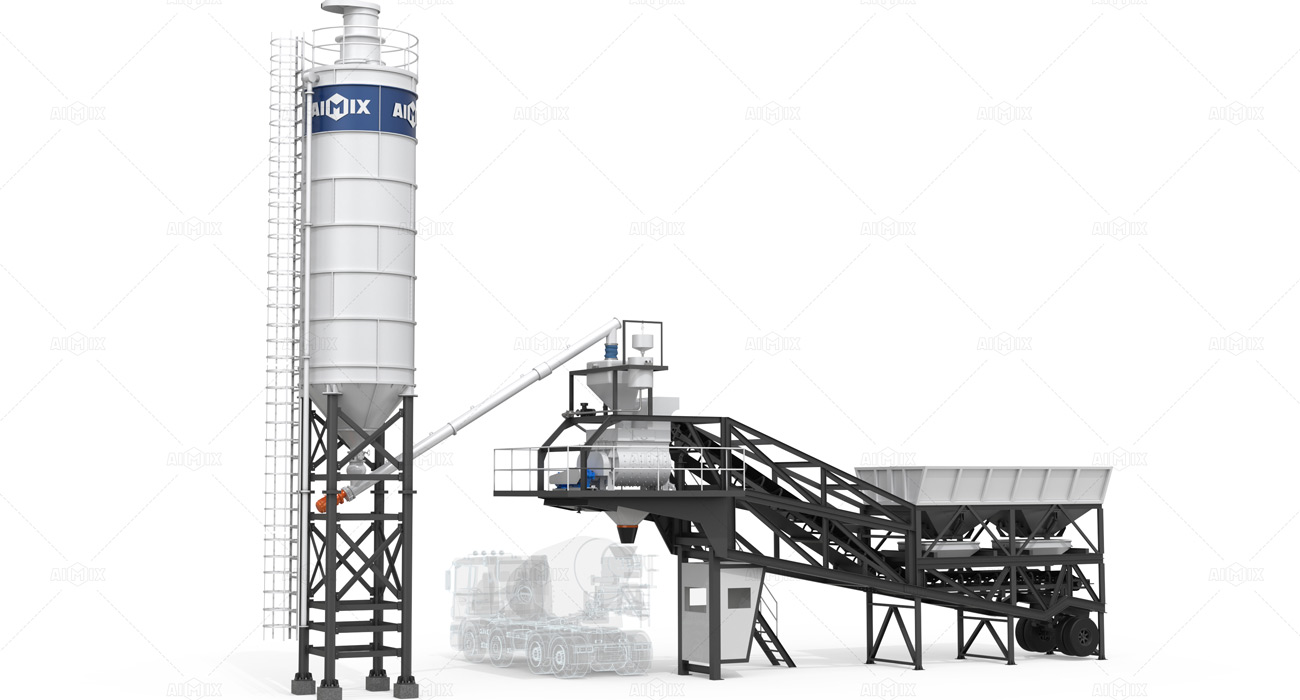
AJY Series—Flexible relocation, an efficient partner for multi-site operations
- Capacity: 25–120 m³/h
- Mixer: Twin-shaft mixer, planetary mixer
- Mixing Cycle: 72 s
- Setup Time: Quick setup time (7–45 days) days)
Representative Model: AJY60
- Integrated mobility, no disassembly required: Designed for semi-trailer towing, allowing the unit to travel directly on public roads; quickly relocate to the next site after project completion without needing a specialized assembly/disassembly team.
- Rapid commissioning, minimized downtime: Production can begin after just 1–3 days of on-site installation and testing—cutting installation time by over 90% compared to stationary plants—ensuring your project schedule isn’t delayed by equipment setup.
- Low site requirements, flexible deployment: Occupies a footprint of 300–500 m²; requires only level ground with a slope of no more than 3°—no prior foundation construction needed—significantly reducing site preparation costs.
- Remote monitoring, real-time status tracking: This mobile concrete batching plant supports remote fault diagnosis, ensuring timely technical support even at remote sites and minimizing downtime losses caused by waiting for repairs.
- Modular structure, easy maintenance: Core components are independently detachable; routine inspections and spare part replacements can be performed without dismantling the entire unit, effectively reducing maintenance-related production downtime.
- Controllable initial investment: Manufacturing and transport costs are lower than stationary plants of equivalent capacity, offering greater financial flexibility for teams with phased project requirements.
| Types | Belt Type | ||
|---|---|---|---|
| Model | AJY-25 | AJY-35 | AJY-50 |
| Theoretical Productivity (m³/h) | 25 | 35 | 50 |
| Mixer Model (Mixer Output L) | JS500 | JS750 | JS1000 |
| Mixer Power (kW) | 18.5 | 30 | 2×18.5 |
| Mixing Cycle Period (s) | 72< | 72 | 72 |
| Rated Input Volume (Model of Batching Machine L) | 800 | 1200 | 1600 |
| Max.Aggregate Size (mm) | Φ60 | Φ60 | Φ60 |
| Standard Aggregate Bin Capacity (m³) | 2×3 | 2×5 | 2×5 |
| Category of Aggregate | 3/4/2002 | ||
| Powder Storage Silo (ton) (Optional) | 1×50 | 2×50 | 1×100 |
| Max. Discharging Height (m) | 3.8 | 3.8 | 4.1 |
| Weighing Range & Accuracy of Aggregate (kg) | (300~1500)±2% | (300~1500)±2% | (300~3000)±2% |
| Weighing Range & Accuracy of Cement (kg) | (100~300)±1% | (100~300)±1% | (250~900)±1% |
| Weighing Range & Accuracy of Water (kg) | (60~150)±1% | (60~150)±1% | (80~300)±1% |
| Weighing Range & Accuracy of Additive (kg) | / | (8~20)±1% | (8~20)±1% |
| Overall Weight (ton) | ≈15 | ≈22 | ≈26 |
| Installation Power (kW) | ≈61 | ≈73 | ≈92 |
| Power Supply | 380V/220V/415/440V, 50/60HZ, 3Phase | ||
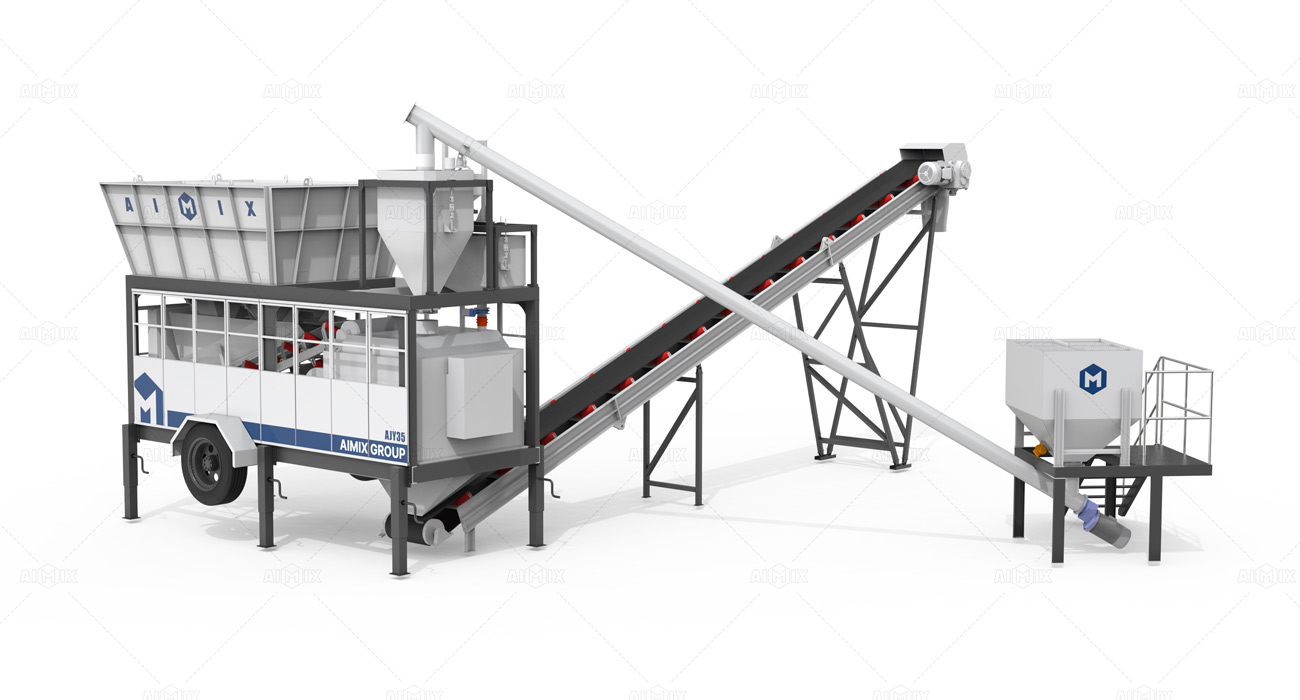
AJSY Series—Lightweight and portable: A rapid-deployment solution for small-scale job sites
- Capacity: 25–50 m³/h
- Mixer: Twin-shaft mixer
- Aggregate Feeder: 2 × 3.5 m³
- Set-Up Time: Fast setup, usually 1–3 days
Representative Model: AJSY35
- Ultra-fast installation: Ready for production the same day it arrives on site. Core components are highly integrated onto a single chassis; the entire installation and commissioning process can be completed by just 1–2 people, eliminating the need for advance foundation preparation or waiting for a professional installation team.
- Single-operator control minimizes labor costs: Features an innovative smart wireless remote control mode, allowing one person to manage the entire process—batching, mixing, and discharging—thereby reducing reliance on manual labor.
- 30% increase in mixing output: An upgraded mixing system structure in this small concrete batch plant significantly boosts the volume of concrete mixed within the same timeframe compared to the previous generation, enabling high production efficiency even with compact equipment.
- 50% increase in loading efficiency: A single-conveyor loading design cuts loading time in half; combined with a workflow where weighing and mixing occur simultaneously, it enables continuous, uninterrupted production.
- Compact footprint, flexible positioning near the work site: Requires only 200 m² for deployment and can be placed directly next to building foundations or at the edge of road construction zones, shortening concrete transport distances and minimizing the risk of segregation.
- Low-cost, self-service maintenance: Simplified structure with wear parts limited primarily to mixing blades and liners; on-site operators can replace these parts themselves without needing professional maintenance personnel, saving on external repair costs.
| Parameter | AJSY20 | AJSY40 |
|---|---|---|
| Theoretical productivity (m³/h) | 20 | 40 |
| Mixer discharge volume (L) | 500 | 1000 |
| Mixer feeding volume (L) | 750 | 1500 |
| Mixer power (kw) | 18.5 | 18.5×2 |
| Discharge height (m) | 4.1 | 4.1 |
| Aggregate bin configuration (number × single bin volume, m³) | 2×4.5 | 2×4.5 |
| Cycle time (s) | 60 | 60 |
| Maximum aggregate particle size (mm) | 60/80 | 60/80 |
| Cement silo (optional) | 1×100 | 1×100 |
| Aggregate weighing system | ±2% | ±2% |
| Powder weighing system | ±1% | ±1% |
| Water weighing system | ±1% | ±1% |
| Additive weighing system | ±1% | ±1% |
| Installed power (kw) | ≈50 | ≈70 |
| Control mode | Buttons + Touch Screen + Remote Control | |
| Power supply | 220V/415V/440V/380V, 50Hz/60Hz, three-phase | |
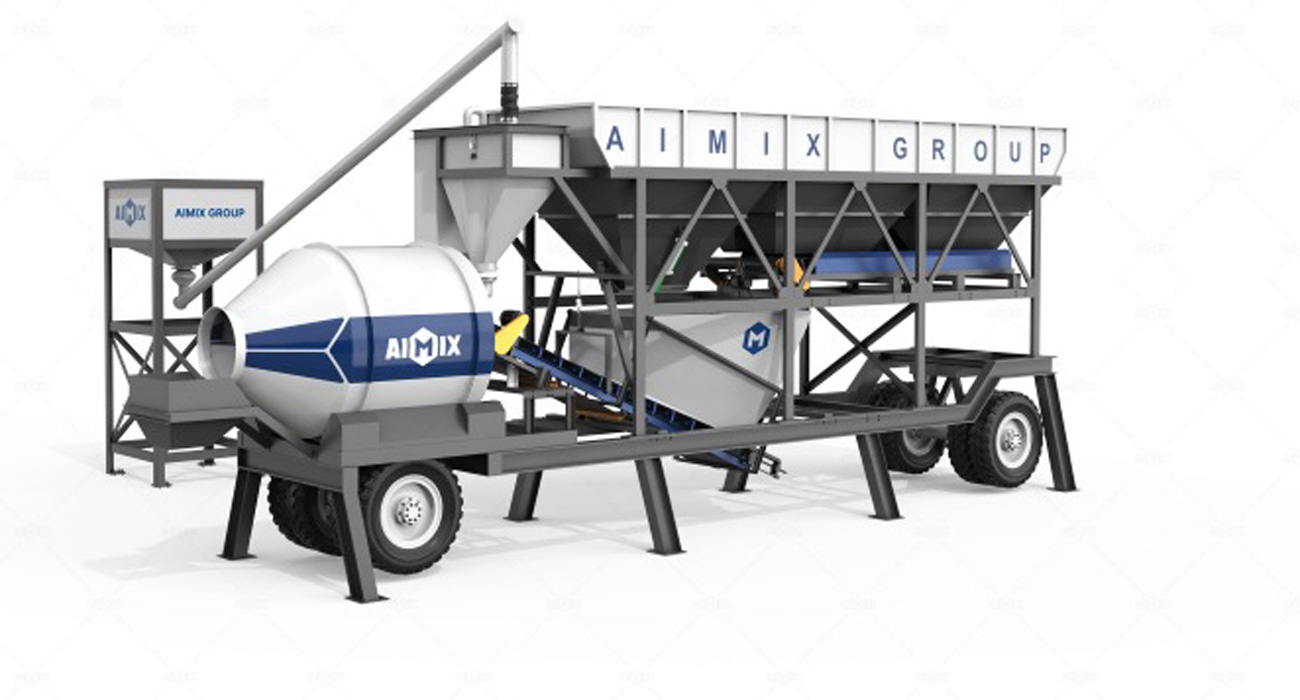
AJZY Series—A lightweight, drum-style portable option with the lowest barrier to operation
- Capacity: 40–60 m³/h
- Mixer Type: Gravity-Type Drum Mixer (JZM750–JZM1500)
- Installation Time: 1–2 Days
- Control System: PLY1000 Semi-automatic control System
Representative Model: AJZY50
- Integrated transport and immediate operation: All components of the portable batch plants are mounted on a single trailer chassis, eliminating the need for disassembly; simply tow to the site and secure the outriggers to start, bypassing tedious assembly procedures.
- Rapid commissioning to minimize downtime: On-site setup and commissioning take just 1–3 hours, allowing the equipment to enter production quickly without encroaching on valuable construction windows.
- Energy-efficient operation for long-term cost savings: The gravity-based drum mixing principle requires less power than forced-action mixers, resulting in lower daily electricity consumption and more manageable long-term operating costs.
- Simple operation with a short learning curve: The PLY1000 semi-automatic control system features intuitive logic; general workers can master independent operation in just 1–2 hours, reducing staffing requirements.
- Minimal footprint for deployment close to the pour site: With a footprint of only 100–300 m², the equipment can be positioned directly at the work site.
| Parameter | Model | Unit | AJZY-40 | AJZY-60 |
|---|---|---|---|---|
| Theoretical production efficiency | Cubic meters per hour | 30-40 | 50-60 | |
| Drum mixer | -Kilowatts | JZM1000 | JZM1500 | |
| Motor power | kW | 7.5×2 | 11×2 | |
| Mixing time | second | 40 | 40 | |
| Discharge height | meters | 1.3 | 1.3 | |
| Batching machines | Dosing machine | -cubic meters | PLD1200 | PLD1600 |
| Hopper capacity | Cubic meters | 5×2/3 | 8×2/3 | |
| Motor power | kilowatt | 4×2 | 4×3 | |
| Sensor | kilogram | 2000×3 | 2000×3 | |
| Cylinder | - | 100×250 | 100×250 | |
| Belt size | millimeters | 10400×500×2; 4200×500×1 | 10400×500×2; 4200×500×1 |
|
| 9000×600×1 | 9000×600×1 | |||
| Feeding height | millimeter | 3200 | 3200 | |
| Cement weighing system | Weighing precision | - | ±1% | ±1% |
| Water weighing system | Weighing accuracy | - | ±1% | ±1% |
| Pump power | Kilowatts | 3 | 3 | |
| Additive weighing system | Weighing accuracy | - | ±1% | ±1% |
| Additive pump power | Kilowatts | 1.1 | 1.1 | |
| Chassis | (Equipment) Size | millimeter | 8410×2000×780 | 11100×2000×780 |
| Tire size | millimeter | 1000 | 1000 | |
| Control systems | Electronic components | - | ZHENG TAI | ZHENG TAI |
| Control system | - | PLY1000 Semi-automatic control system | PLY1000 Semi-automatic control system |
Offering a comprehensive range of equipment is merely the starting point; the true value lies in the fact that every product has undergone rigorous, targeted engineering validation. Across AIMIX’s four major series of concrete mix